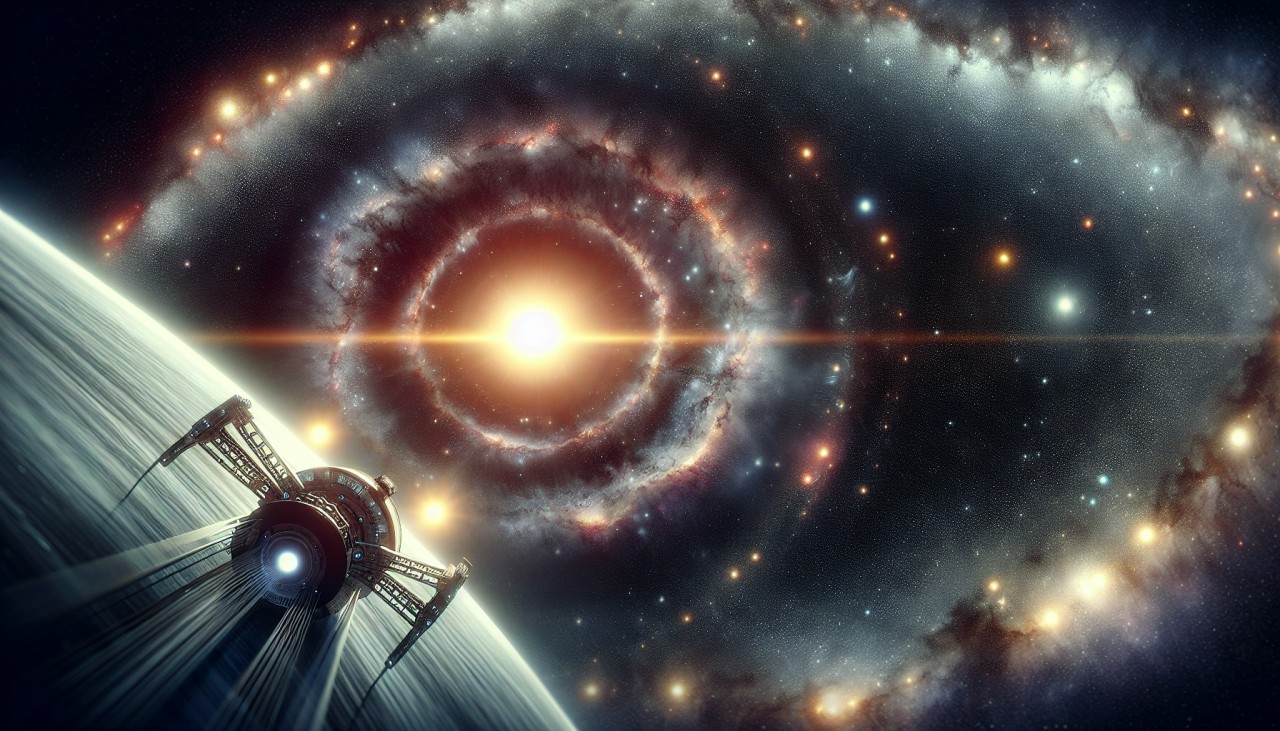
The allure of the stars has captivated human imagination for centuries, inspiring countless myths, legends, and scientific endeavors. In the 20th century, this fascination materialized into tangible missions, most notably the Voyager program. Launched in 1977, Voyager 1 and Voyager 2 embarked on journeys that would see them traverse the vast expanse of our solar system and beyond. Voyager 1, for instance, became the first human-made object to enter interstellar space in 2012, followed by Voyager 2 in 2018. These spacecraft have provided invaluable data about the outer planets and the interstellar medium, offering a glimpse into the conditions that exist beyond the protective bubble of our heliosphere. science.nasa.gov
However, as these missions age and their power supplies diminish, the scientific community has turned its attention to the next generation of interstellar exploration. One such initiative is the Interstellar Mapping and Acceleration Probe (IMAP), launched in September 2025. IMAP aims to study the boundary of the heliosphere, the protective bubble created by the Sun's magnetic field and solar wind, and the interactions between solar and interstellar winds. Positioned at the first Lagrange point (L1), approximately one million miles from Earth toward the Sun, IMAP is poised to provide unprecedented insights into the dynamics of our solar system's outermost regions. en.wikipedia.org
In addition to IMAP, the discovery of interstellar objects like 3I/ATLAS has spurred interest in missions designed to study these fleeting visitors. Discovered in July 2025, 3I/ATLAS is the third known interstellar object to pass through our solar system. Its high speed and trajectory confirm its origin outside the solar system, making it a prime candidate for study. Scientists are evaluating various strategies to observe such objects, including the "chaser" method, which involves sending a spacecraft to intercept the object as it departs the solar system. This approach, first proposed in 2022 to catch up with 'Oumuamua, would require precise timing and significant resources but could yield invaluable data about the composition and behavior of interstellar bodies. livescience.com
The study of interstellar objects also raises the question of extraterrestrial intelligence. In December 2025, astronomers used the Allen Telescope Array to search for technosignatures—indicators of advanced technology—emitted by 3I/ATLAS. Despite detecting nearly 74 million narrowband signals, all were traced back to human-made sources, confirming the object's natural origin. This finding underscores the importance of such missions in distinguishing between natural and artificial phenomena in our quest to understand the cosmos. arxiv.org
Looking ahead, concepts like Project Lyra and Project Dragonfly are exploring the feasibility of laser-propelled interstellar probes. Project Lyra, initiated in 2017, is a feasibility study of a mission to interstellar objects such as 'Oumuamua and 2I/Borisov. In January 2022, researchers proposed that a spacecraft launched from Earth could catch up to 'Oumuamua in 26 years for further close-up studies. en.wikipedia.org Similarly, Project Dragonfly assesses the feasibility of a small spacecraft capable of reaching Alpha Centauri within 100 years using existing or near-term technologies. en.wikipedia.org These initiatives represent the cutting edge of interstellar exploration, aiming to send small, laser-propelled probes to neighboring star systems, potentially revolutionizing our understanding of exoplanetary systems and the conditions necessary for life.
In conclusion, the field of interstellar probes is experiencing a renaissance, driven by technological advancements and a renewed scientific curiosity. From the enduring legacy of the Voyager missions to the ambitious plans of future projects, humanity's quest to explore the stars continues to inspire and challenge us. As we develop and deploy these next-generation probes, we move closer to answering fundamental questions about our place in the universe and the potential for life beyond our solar system.
Key Takeaways
- Voyager 1 and 2 have provided invaluable data about the outer planets and interstellar space since their launches in 1977.
- IMAP, launched in September 2025, aims to study the boundary of the heliosphere and interactions between solar and interstellar winds.
- The discovery of interstellar objects like 3I/ATLAS has spurred interest in missions designed to study these fleeting visitors.
- Projects like Lyra and Dragonfly are exploring the feasibility of laser-propelled interstellar probes to neighboring star systems.
- Advancements in technology and renewed scientific curiosity are driving the next generation of interstellar exploration.