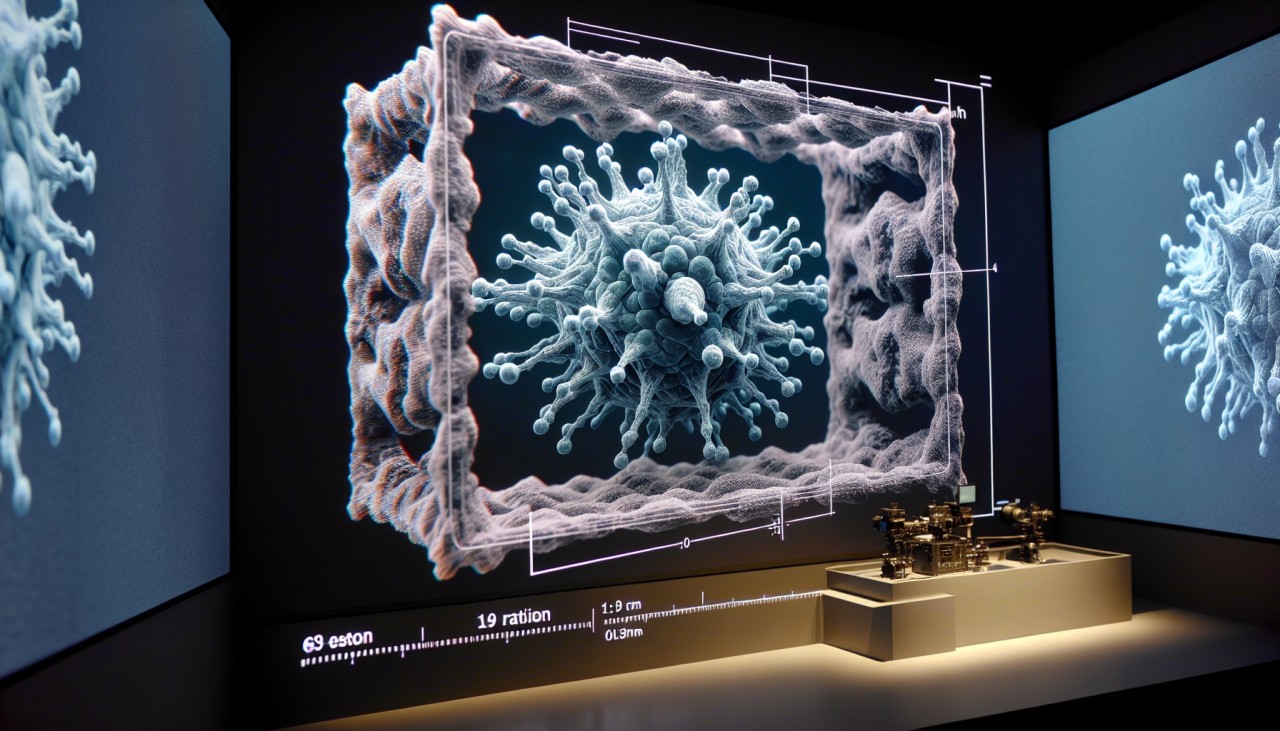
Quantum imaging is a rapidly evolving field that leverages the principles of quantum mechanics to enhance our ability to observe and analyze the microscopic world. By harnessing phenomena such as entanglement and superposition, quantum imaging techniques can surpass the limitations of classical imaging methods, offering unprecedented clarity, sensitivity, and resolution. This advancement has profound implications across various disciplines, including biology, materials science, and environmental monitoring.
One of the most significant breakthroughs in quantum imaging is the development of ultra-thin nonlinear metasurfaces. These innovative structures generate spatially entangled photon pairs, which can be manipulated to achieve high-resolution imaging with a wide field of view. By combining quantum ghost imaging with all-optical scanning methods, researchers have demonstrated the ability to reconstruct images with exceptional detail, even in challenging conditions. This approach not only improves the quality of the images but also reduces the complexity and size of the imaging systems, making them more practical for real-world applications.
Another notable advancement is the creation of quantum lidar systems capable of acquiring real-time 3D images while fully submerged underwater. Traditional imaging techniques often struggle in turbid water due to light scattering and absorption. However, by employing quantum detection technology, these quantum lidar systems can capture detailed information in low-light environments, opening new possibilities for underwater exploration, environmental monitoring, and search and rescue operations. The high sensitivity of quantum sensors allows for the detection of objects and features that would otherwise remain hidden, providing a clearer understanding of underwater ecosystems and geological formations.
In the realm of biological imaging, researchers have achieved a breakthrough by turning fluorescent proteins into biological qubits. This innovation enables quantum sensing within living cells, allowing scientists to monitor and analyze cellular processes at the quantum level. By manipulating these proteins with laser pulses and microwaves, researchers can detect magnetic and electrical signals within cells, providing insights into protein folding, drug interactions, and disease mechanisms. This approach holds the promise of advancing our understanding of complex biological systems and developing more effective medical treatments.
The integration of quantum imaging with existing technologies has also led to the development of quantum cameras that capture significantly more light than standard sensors. These cameras utilize quantum mechanics and artificial intelligence to count individual photons, extracting up to 96% more information from each light ray. This capability results in substantially higher-resolution images, even under low-light conditions, and has potential applications in satellite and space telescope imaging. By deploying these quantum cameras in orbit, scientists can obtain clearer and more detailed images of distant celestial bodies, enhancing our understanding of the universe.
Furthermore, the application of diamond quantum sensors in analyzing the magnetization response of soft magnetic materials used in power electronics has shown promising results. By employing a novel imaging technique, researchers have developed quantum protocols to simultaneously image both the amplitude and phase of AC stray fields over a wide frequency range. This advancement could lead to the development of advanced magnetic materials with improved performance, contributing to more efficient power electronics and energy systems.
The potential applications of quantum imaging are vast and varied. In the field of environmental monitoring, quantum sensors can detect pollutants and hazardous substances at extremely low concentrations, enabling early detection and mitigation of environmental hazards. In materials science, quantum imaging can reveal the structural properties of materials at the atomic level, facilitating the design of new materials with tailored properties. In medicine, quantum imaging techniques can provide detailed images of tissues and organs, aiding in the diagnosis and treatment of diseases.
Despite these advancements, several challenges remain in the practical implementation of quantum imaging technologies. Issues such as maintaining quantum coherence over extended periods, scaling up quantum systems for real-world applications, and integrating quantum sensors with existing technologies need to be addressed. Ongoing research and development efforts are focused on overcoming these obstacles, with the goal of making quantum imaging a mainstream tool in scientific research and industry.
In conclusion, quantum imaging represents a transformative leap in our ability to observe and understand the microscopic world. By harnessing the unique properties of quantum mechanics, researchers are developing imaging systems that offer unprecedented sensitivity, resolution, and clarity. As these technologies continue to mature, they hold the potential to revolutionize various fields, from biology and materials science to environmental monitoring and medicine, paving the way for a deeper and more comprehensive understanding of the world around us.
Key Takeaways
- Ultra-thin nonlinear metasurfaces enable high-resolution imaging with a wide field of view.
- Quantum lidar systems capture real-time 3D images underwater, enhancing environmental monitoring.
- Fluorescent proteins transformed into biological qubits allow quantum sensing within living cells.
- Quantum cameras extract up to 96% more information, improving low-light imaging capabilities.
- Diamond quantum sensors analyze magnetization responses, advancing power electronics performance.
Example
The development of quantum lidar systems capable of acquiring real-time 3D images while fully submerged underwater has significant implications for environmental monitoring. Traditional imaging techniques often struggle in turbid water due to light scattering and absorption, making it challenging to monitor underwater ecosystems and geological formations. Quantum lidar systems, by employing quantum detection technology, can capture detailed information in low-light environments, providing clearer insights into underwater habitats and aiding in the conservation of marine life.