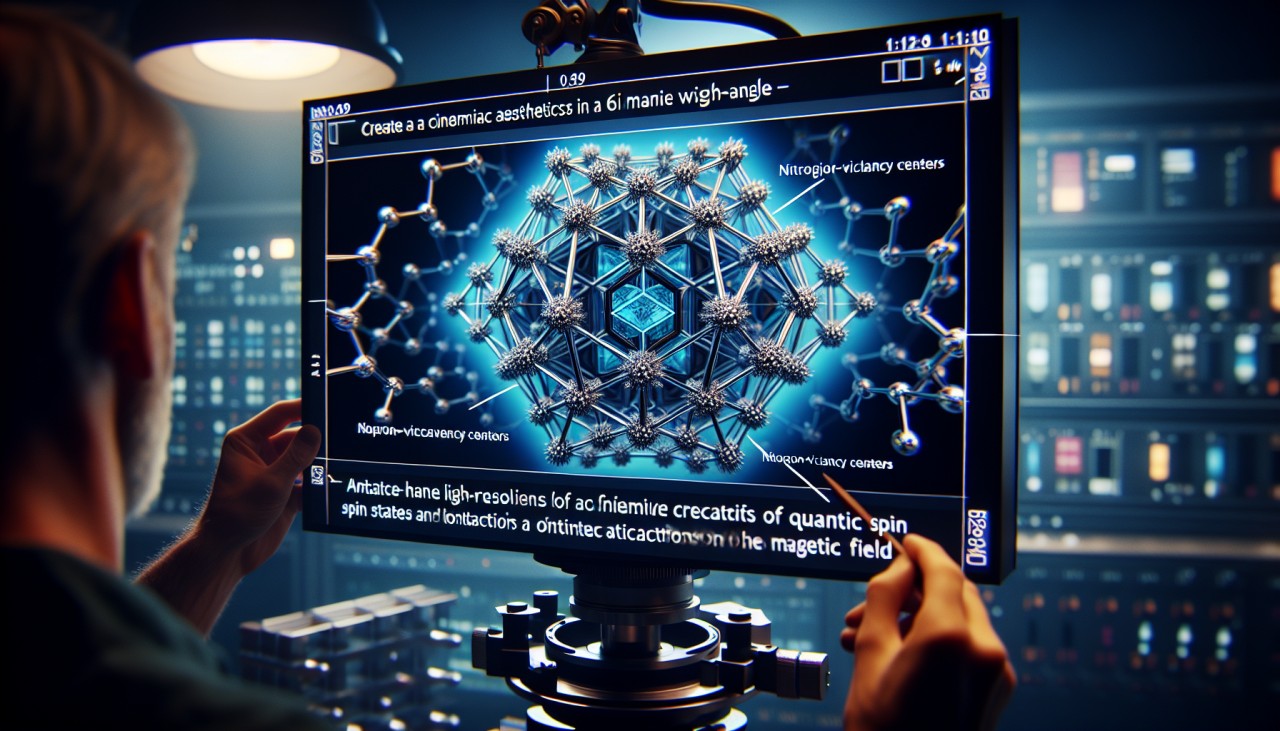
Diamond nitrogen-vacancy (NV) centers have emerged as pivotal components in the realm of quantum technologies, offering unique properties that bridge the gap between quantum mechanics and practical applications. These point defects, consisting of a nitrogen atom adjacent to a vacancy in the diamond lattice, exhibit remarkable spin-dependent photoluminescence and long spin coherence times at room temperature. These characteristics make NV centers ideal candidates for a myriad of applications, including quantum sensing, quantum information processing, and nanoscale imaging.
One of the most significant challenges in harnessing NV centers for quantum applications has been the precise control over their creation and integration within diamond structures. Traditional methods, such as ion implantation, often result in NV centers with varying depths and densities, leading to inconsistencies in performance. However, recent advancements have introduced innovative fabrication techniques that allow for tunable control over both the depth and density of NV centers. For instance, researchers have developed methods to engineer shallow NV centers with depths confined to specific nanometer scales, enhancing their sensitivity and coherence properties. This depth confinement is achieved through controlled doping during diamond growth, resulting in NV centers that are more uniform and stable, thereby improving the overall performance of quantum sensors. arxiv.org
In addition to depth control, the density of NV centers plays a crucial role in the scalability and efficiency of quantum devices. High-density NV centers can lead to increased interactions between individual centers, which, while beneficial for certain applications like quantum entanglement, can also introduce noise and reduce coherence times. Conversely, low-density NV centers may not provide sufficient signal strength for practical applications. Recent studies have focused on achieving a balance by tuning the density of NV centers to optimal levels, thereby enhancing the performance of quantum sensors and information processors. This tunable density approach has been demonstrated in the creation of depth-confined, shallow NV centers with adjustable densities, leading to improved control and sensitivity in quantum measurements. arxiv.org
Material engineering has also played a pivotal role in enhancing the properties of NV centers. The interaction between NV centers and their surrounding environment, particularly the diamond lattice, can significantly affect their quantum properties. By engineering the diamond matrix, researchers have been able to improve the stability and coherence times of NV centers. For example, the incorporation of graphene into diamond structures has been shown to enhance the quantum coherence of shallow NV centers. This hybridization creates a composite material that leverages the strengths of both components, resulting in NV centers with improved performance for quantum sensing applications. eurekalert.org
The integration of NV centers with advanced photonic structures has further propelled the development of quantum technologies. By coupling NV centers with engineered photonic waveguides, researchers have achieved unprecedented control over light-matter interactions. This integration allows for the efficient routing of single photons generated by NV centers, which is essential for quantum communication and information processing. The ability to manipulate the emission properties of NV centers through tailored photonic structures has opened new avenues for on-chip quantum information processing, bringing us closer to practical quantum computing devices. scienmag.com
The scalability of NV center-based quantum technologies has been a topic of extensive research. Traditional methods often faced limitations in scaling up the number of NV centers while maintaining individual control and coherence. Recent advancements have introduced experimental platforms capable of simultaneously addressing multiple NV centers, enabling parallel manipulation and measurement of their spin states. This parallelism not only accelerates quantum measurements but also facilitates the study of collective behaviors and correlations among NV centers, which are crucial for the development of quantum networks and entanglement-based protocols. The ability to scale up NV center systems without compromising individual control marks a significant milestone in the quest for practical quantum technologies. scisimple.com
In the realm of quantum sensing, NV centers have demonstrated exceptional sensitivity to various physical quantities, including magnetic fields, electric fields, temperature, and strain. Their ability to function as nanoscale sensors has been harnessed in diverse applications, from detecting weak magnetic fields in biological systems to probing nanoscale materials. The recent advancements in NV center engineering have further enhanced their sensitivity and spatial resolution, making them invaluable tools in the field of quantum metrology. For instance, the development of depth-confined, shallow NV centers with tunable densities has led to improved sensitivity in nanoscale nuclear magnetic resonance (NMR) and entanglement-enhanced metrology, enabling more precise measurements in complex systems. arxiv.org
The integration of NV centers with other quantum systems has also been a focal point of research. By coupling NV centers with superconducting qubits or other solid-state quantum systems, researchers aim to create hybrid quantum devices that leverage the strengths of each component. These hybrid systems hold the potential for more robust and scalable quantum information processors, combining the long coherence times of NV centers with the fast gate operations of superconducting qubits. The development of such hybrid systems is a promising direction for the future of quantum computing and information processing.
In summary, the recent advancements in diamond NV centers have significantly enhanced their applicability in quantum technologies. Through innovations in fabrication techniques, material engineering, and system integration, NV centers have evolved into versatile and reliable components for quantum sensing and information processing. As research continues to progress, it is anticipated that NV center-based quantum technologies will play a pivotal role in the realization of practical quantum devices, ushering in a new era of quantum innovation.
The practical implications of these advancements are profound. In the field of medical diagnostics, for example, the enhanced sensitivity of NV center-based sensors can lead to the detection of weak magnetic fields associated with neural activity, enabling non-invasive brain imaging techniques. In materials science, the ability to probe nanoscale magnetic fields with high spatial resolution can provide insights into the magnetic properties of novel materials, facilitating the development of next-generation electronic devices. Furthermore, the integration of NV centers with photonic structures can lead to the development of efficient single-photon sources, which are essential for secure quantum communication networks. These real-world applications underscore the transformative potential of NV center-based quantum technologies in addressing complex challenges across various scientific and industrial domains.