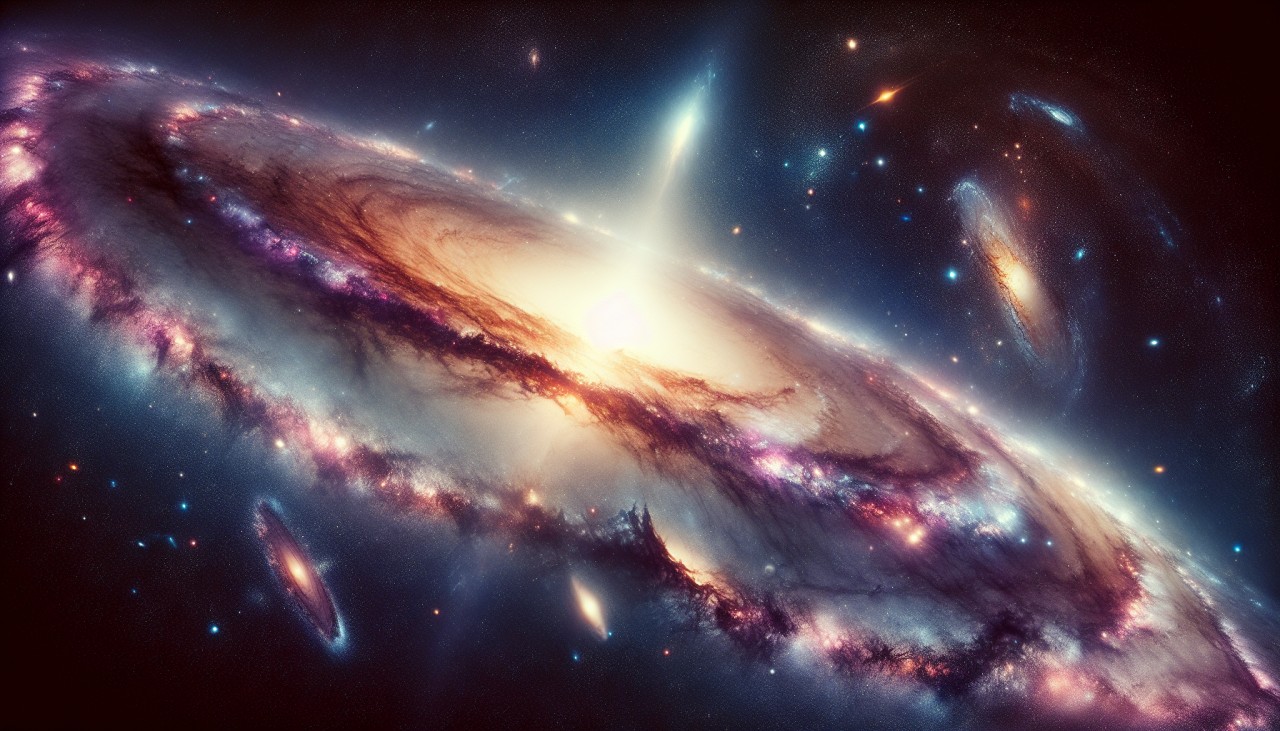
The expansion of the universe has long been a cornerstone of cosmological theory, with observations indicating that galaxies are moving away from each other, suggesting a continually expanding cosmos. However, recent studies have introduced complexities that challenge this understanding, particularly concerning the rate of expansion and the behavior of dark energy. One significant development is the discovery that the Milky Way and its neighboring galaxy, Andromeda, are not receding as expected but are instead on a collision course. This finding was detailed in a study published in Nature Astronomy, which revealed that the gravitational pull between the two galaxies, influenced by their massive dark matter halos, is causing them to draw closer together. This phenomenon stands in contrast to the general trend observed in the universe, where most galaxies are moving away from each other due to the expansion of space. The study suggests that the unique gravitational dynamics between the Milky Way and Andromeda, set against the backdrop of a vast, flat sheet of dark matter and visible mass, are responsible for this anomaly. This sheet extends tens of millions of light-years beyond the Milky Way and Andromeda, counteracting the gravitational pull of the Local Group and causing neighboring galaxies to flow outward along the Hubble flow, consistent with universal expansion. The researchers employed simulations to model galaxy motions and mass distributions since the dawn of the universe, aligning with data from the cosmic microwave background. These models reproduced observed galaxy positions and velocities by embedding them within this large-scale sheet, bordered by nearly empty voids. This discovery not only provides insight into the specific dynamics of the Milky Way and Andromeda but also offers a broader understanding of galactic interactions and the large-scale structure of the universe. It highlights the complexity of cosmic expansion and the need for nuanced models that account for local gravitational influences alongside the general expansion observed on a larger scale. The findings help reconcile long-standing inconsistencies between local galactic dynamics and the prevailing cosmological model (lambda-CDM), suggesting that Andromeda's unique trajectory is due to its position within a dense region of mass, unlike other galaxies that lie in less dense areas and thus follow the general expansion trend. This research underscores the importance of considering both local and universal factors when studying cosmic expansion and galactic movements. It also opens avenues for further investigation into the role of dark matter and gravitational interactions in shaping the cosmos. Understanding these dynamics is crucial for developing accurate models of the universe's evolution and for predicting future galactic interactions. The study's implications extend beyond the Milky Way and Andromeda, prompting scientists to reassess how galactic motions are influenced by both local and large-scale structures. It also raises questions about the fate of other galaxies and the potential for future collisions, which could lead to the formation of new galactic structures. This research contributes to a more comprehensive picture of the universe, integrating observations of galactic movements with theoretical models of cosmic expansion. It emphasizes the need for continuous observation and modeling to refine our understanding of the universe's behavior and to address the complexities that arise from local variations in galactic dynamics. The study's findings are a testament to the evolving nature of cosmology, where new data continually challenge and refine existing theories. They highlight the dynamic interplay between galaxies and the structures they inhabit, offering a glimpse into the intricate processes that govern the cosmos. As research progresses, it is expected that more discoveries will shed light on the factors influencing galactic movements and the overall expansion of the universe, leading to a deeper understanding of the forces at play in the cosmos.
In addition to these findings, other recent studies have further complicated our understanding of the universe's expansion. A notable example is the research published in The Guardian, which casts doubt on the previously accepted theory that the universe's expansion is accelerating. This study suggests that the expansion may, in fact, be slowing down. The researchers argue that the observations of distant supernovae, which led to the discovery of dark energy and the acceleration of the universe's expansion, might be influenced by variations in the properties of stars in the early universe. By estimating the ages of 300 host galaxies using a different method, the team concluded that there are variations in the properties of stars in the early universe that mean they produce, on average, fainter supernovae. This correction implies that the expansion of the universe has slowed down and that dark energy is weakening over time. If these results are confirmed, it would mark a significant paradigm shift in cosmology since the discovery of dark energy 27 years ago. The study's lead author, Professor Young-Wook Lee of Yonsei University in South Korea, stated, "Our study shows that the universe has already entered a phase of decelerated expansion at the present epoch and that dark energy evolves with time much more rapidly than previously thought." This research challenges the prevailing cosmological model and suggests that the fate of the universe could involve a reverse big bang scenario known as the big crunch. The findings have been met with skepticism, but they have also sparked a renewed debate in the scientific community about the nature of dark energy and the ultimate fate of the universe. The implications of this study are profound, as they suggest that our current understanding of the universe's expansion may be incomplete. The possibility that dark energy is weakening over time raises questions about the long-term behavior of the cosmos and the forces that drive its evolution. Further research and observations are needed to confirm these findings and to determine their implications for cosmological theories. The study's conclusions are based on a reanalysis of supernova data, taking into account potential systematic biases that could have influenced previous measurements. By correcting for these biases, the researchers propose a different interpretation of the data, leading to the conclusion that the universe's expansion is slowing down rather than accelerating. This approach highlights the importance of critically examining existing data and considering alternative explanations for observed phenomena. The study also underscores the complexity of measuring cosmic expansion and the challenges involved in interpreting astronomical observations. The debate over the universe's expansion rate, known as the Hubble tension, has been ongoing for years, with different methods yielding conflicting results. This new research adds another layer of complexity to the discussion and emphasizes the need for a comprehensive understanding of the factors that influence cosmic expansion. The scientific community remains divided over these findings, with some researchers advocating for further investigation and others questioning the validity of the proposed model. The resolution of this debate will require a combination of theoretical work, observational data, and experimental validation. As cosmologists continue to explore the mysteries of the universe, studies like this one play a crucial role in challenging existing paradigms and driving the field forward. They encourage scientists to question assumptions, refine models, and seek a deeper understanding of the cosmos. The ongoing research into the universe's expansion is a testament to the dynamic nature of science and the relentless pursuit of knowledge. It reflects the scientific community's commitment to uncovering the truths about the universe, even when those truths challenge long-held beliefs. The findings from this study contribute to the broader discourse on cosmic expansion and provide a foundation for future research that may lead to a more accurate and comprehensive understanding of the universe's evolution. As new data becomes available and analytical techniques improve, our comprehension of cosmic expansion will continue to evolve, potentially leading to groundbreaking discoveries that reshape our view of the cosmos.
Key Takeaways
- Recent studies challenge the prevailing theory of the universe's expansion.
- The Milky Way and Andromeda galaxies are on a collision course, defying the general expansion trend.
- New research suggests the universe's expansion may be slowing down, not accelerating.
- These findings prompt a reevaluation of cosmological models and the nature of dark energy.
- Ongoing research is crucial to resolving these discrepancies and advancing our understanding of the cosmos.