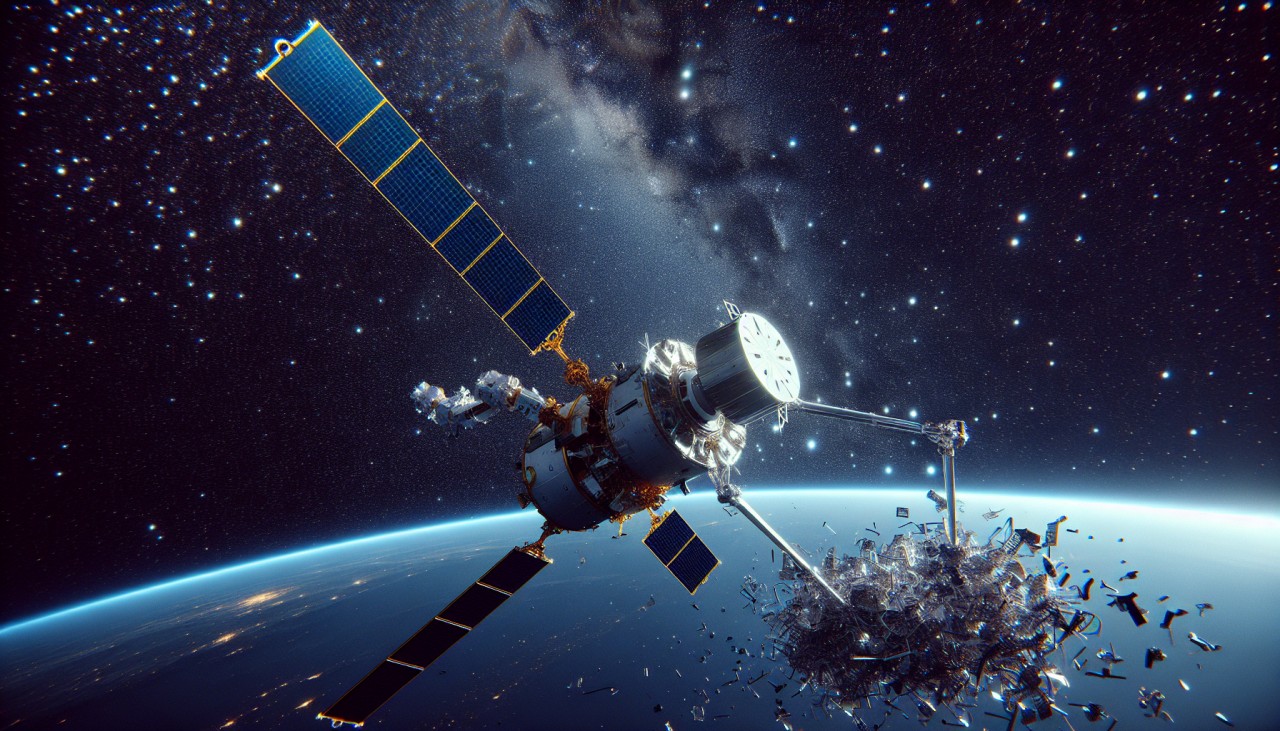
The vast expanse of space surrounding Earth has become a bustling highway for satellites, space stations, and exploratory missions. However, this surge in space activity has led to a significant accumulation of space debris—defunct satellites, spent rocket stages, and fragments from collisions. The European Space Agency (ESA) estimates that over 1.2 million debris particles larger than 1 cm exist in orbit, each capable of damaging operational satellites or spacecraft. livescience.com
One of the most promising initiatives to tackle this challenge is the ClearSpace-1 mission, a collaboration between ESA and the Swiss startup ClearSpace SA. Scheduled for launch in 2025, ClearSpace-1 aims to demonstrate the removal of space debris by capturing and deorbiting the Vespa payload adapter, a 112-kilogram piece of debris from a 2013 Vega rocket launch. This mission will showcase rendezvous, capture, and deorbit technologies, marking a significant step toward active debris removal. esa.int
In the United States, the U.S. Space Force has awarded a $52.5 million contract to Starfish Space, a Washington-based company, to deorbit satellites from the Proliferated Warfighter Space Architecture (PWSA) constellation. Utilizing its Otter spacecraft, Starfish Space plans to capture and safely deorbit at least one satellite, with the mission slated for 2027. This contract represents a pioneering effort in satellite end-of-life disposal services for low Earth orbit constellations. space.com
Technological advancements are also playing a crucial role in debris detection and mitigation. The DebriSense-THz system introduces a Terahertz-Enabled Debris Sensing technology that leverages Integrated Sensing and Communications (ISAC) to detect and classify debris in low Earth orbit. By employing machine learning techniques and a comprehensive THz channel model, DebriSense-THz has demonstrated significant improvements in debris detection accuracy, achieving 95-99% accuracy at 5 THz compared to 62-81% at 30 GHz. arxiv.org
The proliferation of small satellite constellations, such as SpaceX's Starlink and Amazon's Project Kuiper, has intensified the need for effective debris management strategies. These mega-constellations aim to provide global internet coverage but also contribute to the growing congestion in low Earth orbit. The risk of collisions is amplified by debris traveling at speeds of 17,500 mph, and even tiny fragments can cause catastrophic damage. Experts suggest adopting "leave no trace" standards, collision-detection systems, and coordinated satellite maneuvering for safety. space.com
International collaboration is essential in addressing the space debris issue. The United Nations Office for Outer Space Affairs (UNOOSA) has been working on guidelines for the long-term sustainability of space activities, emphasizing the importance of debris mitigation measures. These guidelines encourage member states to implement best practices for debris prevention and removal, fostering a collective approach to preserving the space environment.
In conclusion, the growing challenge of space debris necessitates a multifaceted approach, combining technological innovation, international cooperation, and proactive policy measures. Initiatives like ClearSpace-1 and Starfish Space's deorbiting mission represent significant strides toward mitigating the risks associated with space debris, ensuring the continued viability of space operations for future generations.
Key Takeaways
- ClearSpace-1 mission aims to demonstrate active debris removal by capturing and deorbiting a piece of space debris.
- The U.S. Space Force has awarded a $52.5 million contract to Starfish Space for satellite end-of-life disposal services.
- DebriSense-THz system introduces Terahertz-Enabled Debris Sensing technology for improved debris detection in low Earth orbit.
- Proliferation of small satellite constellations increases the need for effective debris management strategies.
- International collaboration and adherence to UNOOSA guidelines are crucial for the long-term sustainability of space activities.