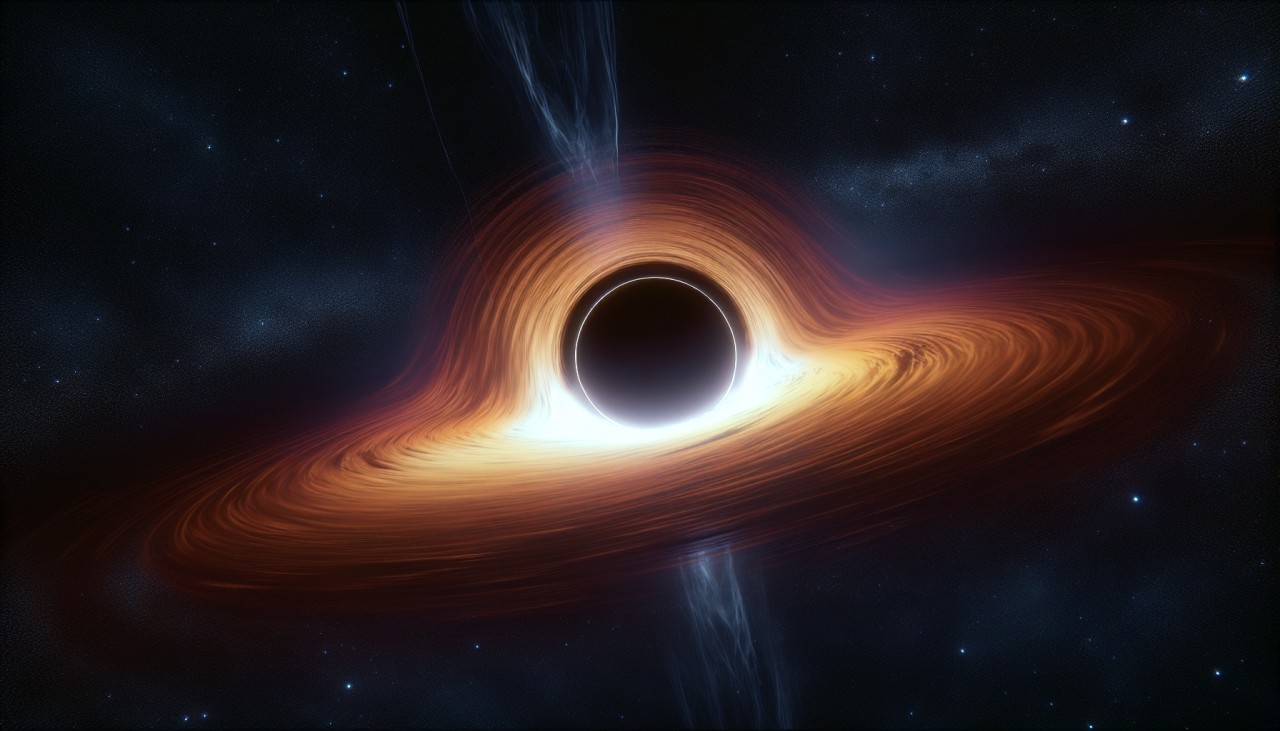
Black holes, those enigmatic regions in space where gravity is so intense that nothing—not even light—can escape, have long captivated scientists and the public alike. Recent advancements in black hole research have provided unprecedented insights into these cosmic giants, reshaping our understanding of the universe's most mysterious phenomena. From the first-ever image of a black hole to the detection of gravitational waves from their mergers, the past few years have been marked by groundbreaking discoveries that have propelled astrophysics into a new era.
In April 2019, the Event Horizon Telescope (EHT) collaboration unveiled the first direct image of a black hole, capturing the supermassive black hole at the center of the galaxy M87. This monumental achievement not only confirmed Einstein's theory of general relativity under extreme conditions but also opened a new window into observing these elusive objects. The EHT's global network of radio telescopes combined data to produce an image of the black hole's event horizon, providing a visual confirmation of their existence and offering a glimpse into their complex structures.
Following this, the detection of gravitational waves—ripples in spacetime caused by accelerating masses like merging black holes—has revolutionized our understanding of the cosmos. The Laser Interferometer Gravitational-Wave Observatory (LIGO) has observed multiple black hole mergers, each providing unique insights into their properties and the dynamics of such catastrophic events. For instance, the detection of GW250114 in January 2025 marked the clearest gravitational wave signal received to date, with a signal-to-noise ratio of about 77-80, far surpassing previous observations. This event not only confirmed the existence of black hole mergers but also provided a test for Einstein's theory of general relativity under extreme conditions.
The James Webb Space Telescope (JWST), launched in December 2021, has further expanded our capabilities in black hole research. In January 2026, JWST captured its sharpest image to date of the region around a supermassive black hole in the Circinus galaxy, located 14 million light-years from Earth. This breakthrough provided a major clue to a long-standing astronomical mystery: the source of unexpected excess infrared emissions near active supermassive black holes. While previous theories suggested these emissions came from black hole outflows, JWST data revealed that approximately 87% originate from the dust disk feeding the black hole, overturning previous assumptions and enhancing our understanding of black hole growth and their impact on galaxy evolution.
In addition to observational advancements, theoretical research has also progressed significantly. A study by the University of Sheffield in March 2025 proposed a revolutionary link between black holes, time, and dark energy. The research suggests that black holes may transition into 'white holes,' ejecting matter and potentially even time back into the universe, defying our current understanding of these cosmic giants. This concept challenges existing theories and opens new avenues for exploring the fundamental nature of the universe.
Moreover, the detection of the most distant supermassive black hole ever found, located 13.2 billion light-years away in the galaxy UHZ-1, has provided insights into the early universe. This discovery, made using both the Chandra X-ray Observatory and JWST, indicates that supermassive black holes were forming when the universe was only about 450 million years old, offering valuable information about the conditions and processes in the early cosmos.
These advancements in black hole research are not only expanding our knowledge of these cosmic entities but also enhancing our understanding of fundamental physics, galaxy formation, and the evolution of the universe. As technology and observational techniques continue to improve, we can anticipate even more groundbreaking discoveries in the near future, further unraveling the mysteries of black holes and their role in the cosmos.
The study of black holes has also led to the development of innovative technologies and methodologies. The CHIRP (Continuous High-resolution Image Reconstruction using Patch priors) algorithm, for example, was developed to process data collected by the EHT. This Bayesian algorithm performs a deconvolution on images created in radio astronomy, allowing for more accurate and detailed images of black holes. The development of CHIRP involved a large team of researchers from MIT's Computer Science and Artificial Intelligence Laboratory, the Center for Astrophysics Harvard & Smithsonian, and the MIT Haystack Observatory, and was first presented publicly by Katherine L. Bouman at the IEEE Computer Vision and Pattern Recognition conference in June 2016.
Furthermore, the application of artificial intelligence (AI) in black hole research has opened new frontiers. Vanderbilt University's AI for New Messengers fellowship, launched in 2024, applies AI techniques to analyze data from cosmic events, such as black hole collisions, using information from the LIGO experiment. The program's inaugural fellow, Chayan Chatterjee, has made significant breakthroughs, with his work using deep learning to analyze gravitational wave data resulting in two groundbreaking papers published in The Astrophysical Journal. This achievement represents a major leap forward in the study of black holes and the development of AI technologies.
In summary, the field of black hole research has experienced remarkable progress, with significant advancements in both observational capabilities and theoretical understanding. The combination of cutting-edge technologies, innovative methodologies, and interdisciplinary collaborations continues to drive the exploration of these cosmic giants, promising even more exciting discoveries in the future.
Key Takeaways
- The Event Horizon Telescope collaboration unveiled the first direct image of a black hole in 2019, confirming Einstein's theory of general relativity under extreme conditions.
- The detection of gravitational waves by LIGO has provided unique insights into black hole mergers, with events like GW250114 offering tests for general relativity.
- The James Webb Space Telescope has captured detailed images of supermassive black holes, revealing that excess infrared emissions originate from the dust disk feeding the black hole.
- The University of Sheffield's research suggests that black holes may transition into 'white holes,' ejecting matter and potentially even time back into the universe, challenging current theories.
- Vanderbilt University's AI for New Messengers fellowship applies AI techniques to analyze data from cosmic events, leading to significant breakthroughs in black hole research.