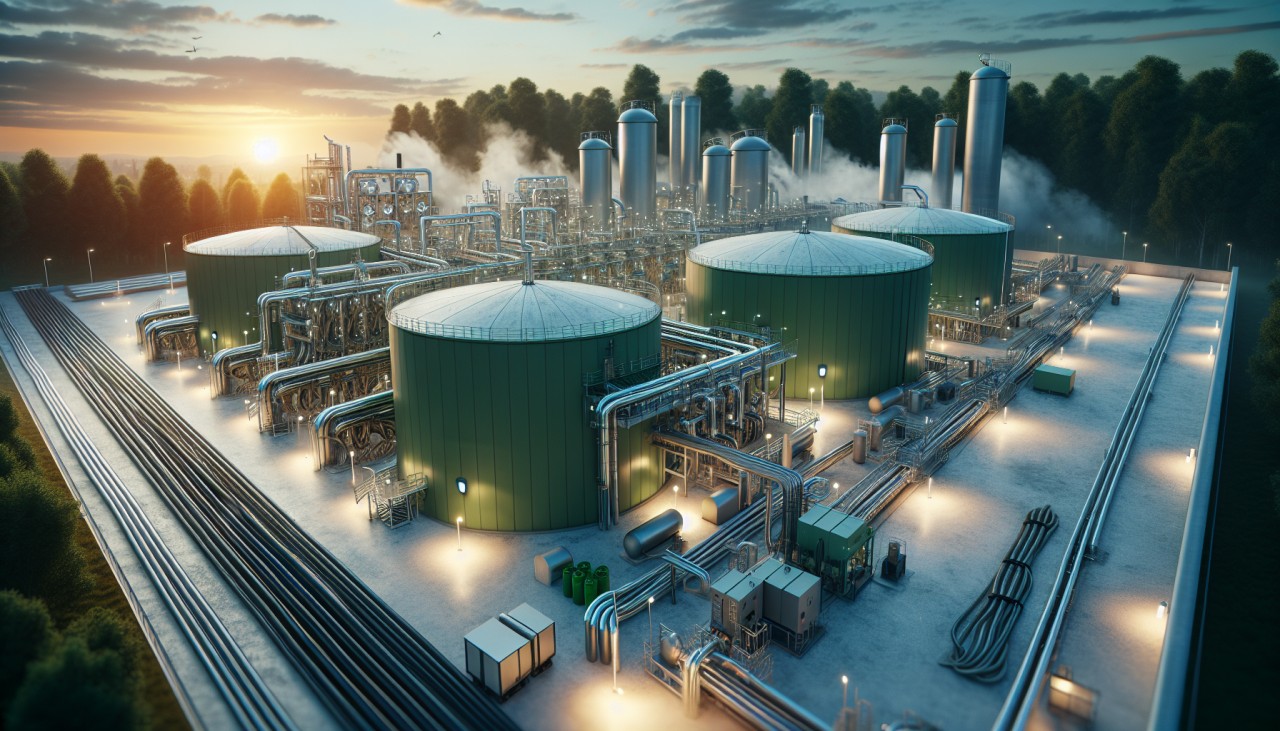
Anaerobic digestion (AD) is a biological process that decomposes organic materials in the absence of oxygen, producing biogas primarily composed of methane and carbon dioxide. This process not only generates renewable energy but also offers an effective solution for managing various waste streams, including agricultural residues, food waste, and wastewater sludge. The significance of AD has been increasingly recognized in recent years, leading to substantial advancements in technology, policy support, and global adoption.
One of the most notable developments in AD technology is the enhancement of digester designs. Traditional anaerobic digesters often faced challenges such as low efficiency and limited scalability. However, modern innovations have addressed these issues, leading to more efficient and adaptable systems. For instance, the introduction of continuous stirred-tank reactors (CSTR), upflow anaerobic sludge blanket (UASB) reactors, and internal circulation (IC) reactors has significantly improved process stability and biogas production rates. These advanced designs allow for better handling of complex feedstocks and have been instrumental in increasing the viability of AD for diverse applications. fortunebusinessinsights.com
In March 2025, EnviTec Biogas, a leading company in the field, commissioned its largest anaerobic digestion facility in the United States. Located in South Dakota, this facility processes excess manure from over 9,500 dairy cows daily, achieving a processing capacity of over 300,000 gallons (1,100 cubic meters) per day. This milestone underscores the growing adoption of AD technologies in large-scale agricultural operations, highlighting their potential to address waste management challenges while generating renewable energy. fortunebusinessinsights.com
The global investment landscape for AD has also seen significant growth. In 2023, the European Union allocated over €2 billion for biogas infrastructure under its REPowerEU plan, with a substantial portion directed towards anaerobic digestion projects. Similarly, the U.S. Department of Agriculture committed USD 400 million through 2024 for renewable energy and waste management initiatives on farms. These investments reflect a strong commitment to integrating AD technologies into national energy and waste management strategies. globalgrowthinsights.com
Private equity and institutional investors are increasingly recognizing the dual benefits of AD projects, which offer both environmental and energy credits. This recognition has led to a surge in funding for AD initiatives, particularly in the Asia-Pacific region, where projects in food processing and municipal waste handling have achieved strong financial closure rates. The establishment of long-term Power Purchase Agreements (PPAs) between bioenergy firms and local utilities has further stabilized returns, making AD projects more attractive to investors. globalgrowthinsights.com
Technological advancements have also played a crucial role in enhancing the efficiency and scalability of AD systems. In 2023, WELTEC BIOPOWER launched a high-efficiency biogas plant featuring thermal pre-treatment technology, which increased methane yield by 15%. Veolia introduced a modular AD system in 2024 targeting food processors and mid-scale waste generators, enabling on-site treatment and energy recovery. These innovations make AD systems more cost-effective and accessible across diverse environments, from urban centers to remote farms. globalgrowthinsights.com
In Japan, compact digesters have been developed for the hospitality industry, particularly urban restaurants, capable of handling up to 500 kg of food waste per day with automated feeding systems. This development addresses the unique challenges of waste management in densely populated areas, demonstrating the adaptability of AD technologies to various settings. globalgrowthinsights.com
The integration of artificial intelligence (AI) into AD processes has further optimized performance. EnviTec Biogas AG announced an AI-integrated plant control platform that optimizes substrate usage and gas output in real time. This advancement enhances the efficiency of AD systems, ensuring optimal performance and energy production. globalgrowthinsights.com
Mobile digesters are now being deployed in military bases and refugee camps across Africa, offering up to 30 kWh/day in biogas-based power. These mobile units provide a sustainable energy solution in areas lacking access to traditional power grids, highlighting the versatility and global applicability of AD technologies. globalgrowthinsights.com
In India, new slurry-to-compressed biogas (CBG) technologies are being rolled out for compressed biogas production from cow dung and municipal sludge. This initiative not only addresses waste management issues but also contributes to the country's renewable energy goals, showcasing the role of AD in sustainable development. globalgrowthinsights.com
The by-products of AD, particularly digestate, are being marketed as certified organic fertilizers in the European Union and the United States. This development adds value to the AD process, creating a circular economy where waste is transformed into valuable products, thereby enhancing the economic viability of AD projects. globalgrowthinsights.com
The emergence of Internet of Things (IoT)-integrated digesters with predictive maintenance features is revolutionizing large-scale industrial settings. These smart systems monitor performance in real time, predict maintenance needs, and optimize operations, leading to increased efficiency and reduced downtime. globalgrowthinsights.com
The application of anaerobic digestion extends beyond biogas production. Recent studies have explored the use of AD in producing biohydrogen, a clean fuel alternative. Research indicates that biohydrogen production through AD is a promising avenue, with advancements in technology and substrate utilization enhancing its feasibility. mdpi.com
The integration of abiotic stress factors (ASFs) in AD processes has been shown to enhance the digestibility of feedstocks and improve biomethanation. Studies have demonstrated that applying ASFs such as salinity, micronutrients, and micro-aeration can increase biomethane production by up to 49%, highlighting the potential for optimizing AD processes through environmental manipulation. sciencedirect.com
The development of advanced modeling techniques, such as the Coupled Hydrodynamics and Anaerobic Digestion (CHAD) toolbox, has improved the simulation and optimization of AD processes. By integrating computational fluid dynamics (CFD) with anaerobic digestion models, CHAD enhances the accuracy of predictions, aiding in the design and operation of more efficient AD systems. arxiv.org
Despite these advancements, challenges remain in the widespread adoption of AD technologies. Issues such as feedstock variability, process inhibition, and the need for substantial initial investment can hinder the implementation of AD systems. Addressing these challenges requires continued research, supportive policies, and investment in infrastructure to realize the full potential of anaerobic digestion in sustainable waste management and renewable energy production.
In conclusion, anaerobic digestion is at the forefront of transforming waste into valuable resources, offering a sustainable solution to global energy and environmental challenges. Ongoing technological innovations, supportive policies, and increased investment are driving the growth and adoption of AD systems worldwide, paving the way for a more sustainable and circular economy.
Key Takeaways
- Advanced digester designs have improved efficiency and scalability of AD systems.
- Global investments in AD technologies are accelerating, with significant funding from governmental and private sectors.
- Innovations such as AI integration and mobile digesters are expanding the applicability of AD across various sectors.
- AD is contributing to the production of biohydrogen and organic fertilizers, enhancing its role in sustainable development.
- Advanced modeling techniques are optimizing AD processes, leading to more efficient and effective systems.