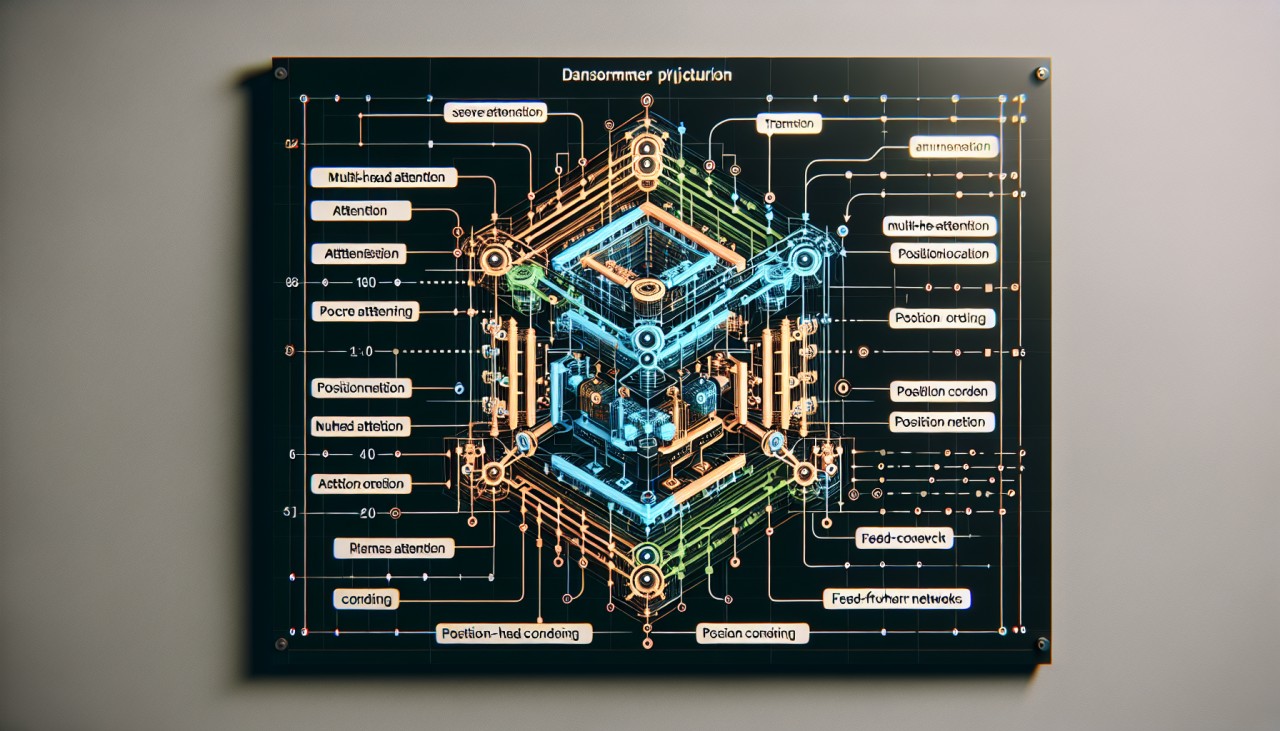
The advent of Transformer architectures has marked a pivotal moment in the field of machine learning, particularly in natural language processing (NLP) and computer vision. Introduced in the seminal 2017 paper "Attention is All You Need" by Vaswani et al., Transformers have fundamentally transformed how machines understand and generate human language. Unlike their predecessors, such as recurrent neural networks (RNNs) and convolutional neural networks (CNNs), Transformers leverage a mechanism called self-attention, allowing them to process entire sequences of data simultaneously. This parallel processing capability significantly reduces training times and enhances the model's ability to capture long-range dependencies within the data.
At the core of Transformer architecture is the self-attention mechanism, which enables the model to weigh the importance of different words in a sentence, regardless of their position. This contrasts with RNNs, which process data sequentially and often struggle with long-term dependencies due to issues like vanishing gradients. By assigning varying attention scores to words, Transformers can focus on relevant parts of the input sequence, leading to more accurate and context-aware representations. This innovation has been particularly beneficial in tasks such as machine translation, where understanding the context of each word is crucial for accurate translation.
Another significant advancement is the introduction of multi-head attention. Instead of having a single attention mechanism, Transformers utilize multiple attention heads running in parallel. Each head captures different relationships or patterns in the data, enriching the model’s understanding. This approach allows the model to attend to various aspects of the input simultaneously, leading to a more nuanced and comprehensive representation of the data. The combination of self-attention and multi-head attention has enabled Transformers to achieve state-of-the-art performance across a wide range of NLP tasks, including text classification, sentiment analysis, and question answering.
Positional encoding is another critical component of Transformer models. Unlike RNNs, which process data sequentially and inherently understand the order of words, Transformers process all words in a sequence simultaneously. To compensate for this lack of inherent order, positional encodings are added to the input embeddings, providing information about the position of each word within the sequence. This addition allows the model to capture the sequential nature of language, ensuring that the order of words is considered in the learning process. The design of positional encodings, often based on sine and cosine functions, ensures that the model can generalize to sequences of varying lengths and positions.
The success of Transformer architectures has led to the development of numerous variants and applications. In computer vision, models like the Vision Transformer (ViT) have demonstrated that Transformers can be effectively applied to image data. ViTs divide images into fixed-size patches, flatten them, and treat them similarly to sequences of words in NLP tasks. This approach has achieved competitive performance compared to traditional CNNs, highlighting the versatility of Transformer models beyond text data. Additionally, the Swin Transformer introduced a hierarchical design with shifted windows, improving computational efficiency and scalability, making it suitable for dense prediction tasks such as object detection and semantic segmentation.
In the realm of NLP, models like BERT (Bidirectional Encoder Representations from Transformers) have set new benchmarks. BERT employs a bidirectional attention mechanism, allowing it to consider the context from both directions in a sentence, leading to a deeper understanding of language nuances. This bidirectional approach has been particularly effective in tasks that require a comprehensive understanding of context, such as question answering and language inference. BERT's success has spurred the development of numerous derivatives and fine-tuned models, each tailored for specific applications and languages.
The versatility of Transformer architectures has also led to their application in other domains. For instance, TabPFN (Tabular Prior-data Fitted Network) is a Transformer-based model designed for tabular data, enabling accurate predictions on small datasets. This adaptation demonstrates the flexibility of Transformer models in handling various data types and tasks, extending their applicability beyond traditional domains. Similarly, the Perceiver model introduced by DeepMind is designed to process arbitrary forms of data, including images, sounds, and video, using an asymmetric attention mechanism to distill inputs into a latent bottleneck. This general-purpose design allows the Perceiver to learn from large amounts of heterogeneous data, showcasing the adaptability of Transformer architectures to diverse applications.
Despite their successes, Transformer models are not without challenges. One notable issue is their computational and memory requirements, especially when processing long sequences. The self-attention mechanism, while powerful, has a quadratic complexity with respect to the sequence length, making it computationally intensive for long inputs. To address this, researchers have developed various strategies, such as sparse attention mechanisms and hierarchical models, to reduce computational overhead while maintaining performance. Additionally, the need for large amounts of labeled data for training remains a challenge, particularly in specialized domains where annotated datasets are scarce.
Looking ahead, the future of Transformer architectures appears promising. Ongoing research aims to make these models more efficient, interpretable, and adaptable to a broader range of tasks. Innovations like the Mamba architecture, which integrates the Structured State Space sequence model (S4), aim to address some of the limitations of traditional Transformers, particularly in processing long sequences. Mamba combines the strengths of continuous-time, recurrent, and convolutional models, enabling it to handle irregularly sampled data and maintain computational efficiency. This development signifies a move towards more efficient and scalable models capable of handling complex and diverse data types.
In summary, Transformer architectures have revolutionized machine learning by providing a robust framework for processing sequential data. Their ability to capture long-range dependencies, process data in parallel, and adapt to various domains has led to significant advancements in NLP, computer vision, and beyond. As research continues, Transformer models are expected to become more efficient and versatile, further solidifying their role as a cornerstone of modern machine learning.
The rapid evolution of Transformer architectures has not only transformed the landscape of machine learning but also spurred a wave of innovation across various domains. Their adaptability and scalability have led to the development of models that push the boundaries of what is possible in artificial intelligence. One such advancement is the introduction of the Perceiver model by DeepMind, which addresses the challenge of processing diverse and unstructured data types. Unlike traditional Transformers that are often tailored for specific modalities, the Perceiver employs an asymmetric attention mechanism to distill inputs into a latent bottleneck, enabling it to handle arbitrary forms of data, including images, sounds, and video. This design allows the Perceiver to learn from large amounts of heterogeneous data, making it a versatile tool for a wide range of applications.
The Perceiver's architecture consists of two main components: a latent array and an attention mechanism. The latent array serves as a compact representation of the input data, capturing essential features while reducing dimensionality. The attention mechanism then processes this latent array, allowing the model to focus on relevant information and capture complex patterns. This approach not only enhances the model's efficiency but also improves its ability to generalize across different tasks and data types. The success of the Perceiver model underscores the potential of Transformer architectures to adapt to new challenges and expand their applicability beyond traditional domains.
In the realm of computer vision, the Vision Transformer (ViT) has emerged as a formidable alternative to convolutional neural networks (CNNs). ViTs treat images as sequences of patches, applying Transformer models to capture global dependencies and contextual information. This approach has demonstrated competitive performance on benchmark datasets, challenging the dominance of CNNs in image processing tasks. The hierarchical design of ViTs, as seen in models like the Swin Transformer, further enhances their scalability and efficiency, making them suitable for dense prediction tasks such as object detection and semantic segmentation. These developments highlight the growing versatility of Transformer architectures in handling complex visual data.
The success of Transformer models in various domains has also led to the development of specialized architectures tailored for specific tasks. For instance, TabPFN (Tabular Prior-data Fitted Network) is a Transformer-based model designed for tabular data, enabling accurate predictions on small datasets. This adaptation demonstrates the flexibility of Transformer models in handling various data types and tasks, extending their applicability beyond traditional domains. Similarly, the Perceiver model introduced by DeepMind is designed to process arbitrary forms of data, including images, sounds, and video, using an asymmetric attention mechanism to distill inputs into a latent bottleneck. This general-purpose design allows the Perceiver to learn from large amounts of heterogeneous data, showcasing the adaptability of Transformer architectures to diverse applications.
Despite their successes, Transformer models are not without challenges. One notable issue is their computational and memory requirements, especially when processing long sequences. The self-attention mechanism, while powerful, has a quadratic complexity with respect to the sequence length, making it computationally intensive for long inputs. To address this, researchers have developed various strategies, such as sparse attention mechanisms and hierarchical models, to reduce computational overhead while maintaining performance. Additionally, the need for large amounts of labeled data for training remains a challenge, particularly in specialized domains where annotated datasets are scarce.
Looking ahead, the future of Transformer architectures appears promising. Ongoing research aims to make these models more efficient, interpretable, and adaptable to a broader range of tasks. Innovations like the Mamba architecture, which integrates the Structured State Space sequence model (S4), aim to address some of the limitations of traditional Transformers, particularly in processing long sequences. Mamba combines the strengths of continuous-time, recurrent, and convolutional models, enabling it to handle irregularly sampled data and maintain computational efficiency. This development signifies a move towards more efficient and scalable models capable of handling complex and diverse data types.
In summary, Transformer architectures have revolutionized machine learning by providing a robust framework for processing sequential data. Their ability to capture long-range dependencies, process data in parallel, and adapt to various domains has led to significant advancements in NLP, computer vision, and beyond. As research continues, Transformer models are expected to become more efficient and versatile, further solidifying their role as a cornerstone of modern machine learning.
Key Takeaways
- Transformer architectures have revolutionized machine learning by enabling efficient processing of sequential data.
- Self-attention mechanisms allow Transformers to capture long-range dependencies and contextual information.
- Variants like the Vision Transformer (ViT) and Perceiver model demonstrate the versatility of Transformers across different data types.
- Challenges such as computational complexity and data requirements persist, prompting ongoing research into more efficient models.
- Future developments aim to enhance the adaptability and scalability of Transformer architectures for a broader range of applications.