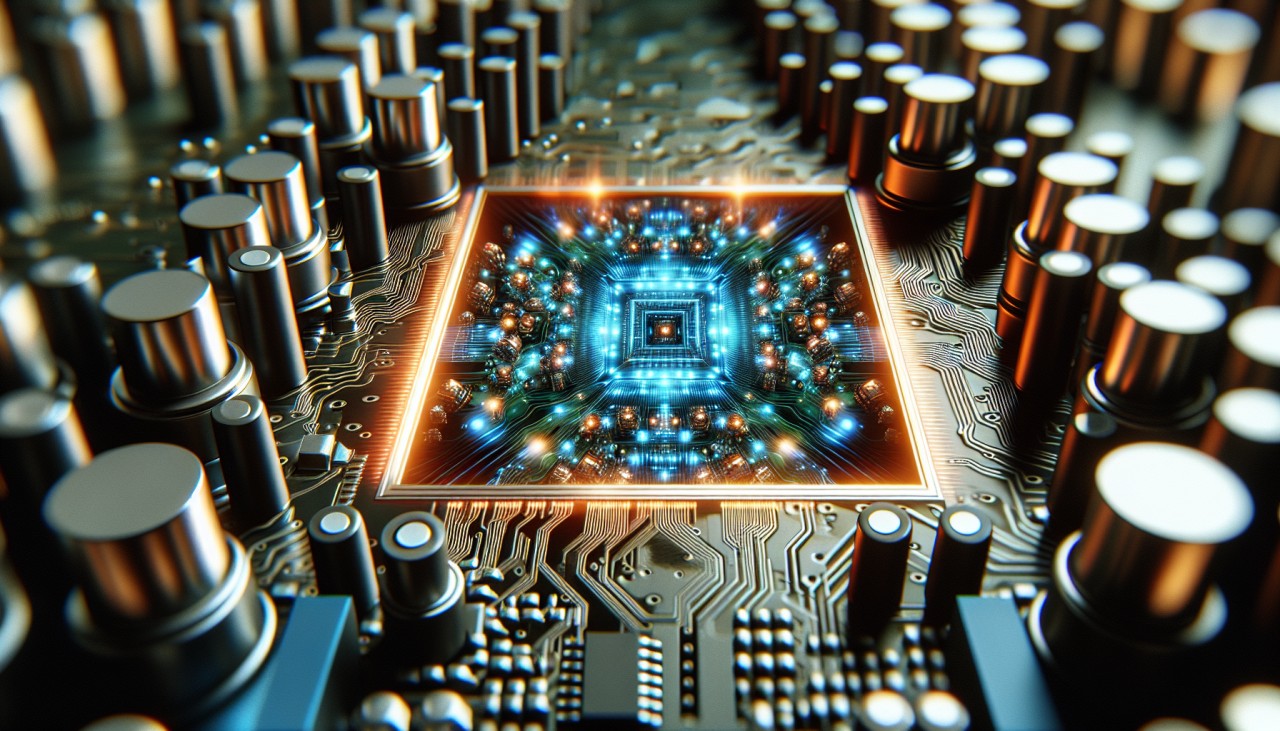
Spintronics, short for spin transport electronics, is an emerging field that exploits the intrinsic spin of electrons, alongside their charge, to develop new types of electronic devices. Unlike traditional electronics, which rely solely on electron charge, spintronics leverages the magnetic moment associated with electron spin to create devices that are faster, more efficient, and capable of retaining information without power. This innovative approach has the potential to revolutionize various sectors, including computing, data storage, and memory technologies.
The foundation of spintronics lies in the manipulation of electron spins within materials. In conventional electronics, data is stored and processed based on the flow of electrons and their charge. Spintronics introduces an additional degree of freedom by utilizing the spin property of electrons, which can be oriented in one of two directions: up or down. This binary nature of spin aligns well with the fundamental requirements of digital information processing.
One of the most significant advancements in spintronics is the development of Magnetoresistive Random Access Memory (MRAM). MRAM stores data by aligning the spins of electrons in magnetic materials, allowing for non-volatile memory that retains information even when power is removed. Unlike traditional volatile memory types, such as Dynamic Random Access Memory (DRAM), MRAM offers faster data access speeds and lower power consumption. This makes MRAM a promising candidate for next-generation memory devices, potentially replacing existing memory technologies in various applications.
Another notable application of spintronics is in the realm of quantum computing. Quantum computers harness the principles of quantum mechanics to perform computations at unprecedented speeds. Spin-based qubits, which utilize the spin states of electrons, are being explored as a means to create more stable and scalable quantum bits. The ability to control and manipulate electron spins with high precision is crucial for the development of practical quantum computers.
Recent research has also focused on the integration of spintronic devices with existing semiconductor technologies. For instance, companies like Intel and Samsung are working on incorporating spintronic elements into their semiconductor processes to enhance device performance and energy efficiency. These efforts aim to bridge the gap between traditional electronics and spintronics, facilitating the widespread adoption of spin-based technologies in consumer electronics.
Despite the promising potential of spintronics, several challenges remain. One of the primary obstacles is the difficulty in achieving efficient spin injection and detection in materials. The spin polarization of electrons can be easily lost due to interactions with impurities or lattice defects, leading to a loss of information. Researchers are actively investigating materials and structures that can maintain spin coherence over longer distances and timescales. Materials such as graphene and topological insulators are being studied for their potential to support long-lived spin states, which are essential for practical spintronic applications.
Another challenge is the integration of spintronic devices with existing electronic systems. The fabrication processes for spintronic components often differ from those used in conventional semiconductor manufacturing, requiring the development of new techniques and materials. Additionally, the scalability of spintronic devices must be addressed to meet the demands of mass production and consumer electronics. Collaborations between academia and industry are crucial in overcoming these hurdles and accelerating the commercialization of spintronic technologies.
In conclusion, spintronics represents a transformative approach to electronics, offering the promise of faster, more efficient, and non-volatile devices. As research progresses and technological challenges are addressed, spintronics is poised to play a pivotal role in the evolution of electronic devices, impacting everything from data storage solutions to the development of quantum computers.
The integration of spintronics into mainstream electronics is not just a theoretical possibility but an impending reality. Ongoing advancements in material science, nanotechnology, and quantum physics are paving the way for the practical application of spintronic devices. For example, recent studies have demonstrated the successful manipulation of electron spins in two-dimensional materials, such as graphene and perovskites, opening new avenues for spintronic applications. These materials offer unique properties, including high electron mobility and tunable electronic characteristics, making them ideal candidates for spintronic devices.
Moreover, the development of spintronic sensors has led to significant improvements in various fields, including medical diagnostics, automotive safety, and consumer electronics. Spintronic sensors are known for their high sensitivity, low power consumption, and resistance to external disturbances, making them suitable for precise measurements in challenging environments. For instance, spintronic sensors are being utilized in magnetic resonance imaging (MRI) systems to enhance image quality and reduce scan times.
The potential of spintronics extends beyond individual devices to the creation of entirely new computing architectures. Spin-based logic gates and circuits are being explored as alternatives to traditional semiconductor-based components. These spintronic circuits could lead to computers that are not only faster but also more energy-efficient, addressing the growing concerns over power consumption in modern computing systems. Additionally, the non-volatile nature of spintronic memory could enable instant-on computing devices, eliminating the need for boot-up sequences and reducing energy usage.
As the field of spintronics continues to evolve, interdisciplinary collaboration will be essential. Physicists, materials scientists, electrical engineers, and computer scientists must work together to overcome the technical challenges and realize the full potential of spintronic technologies. Educational institutions and research organizations play a vital role in training the next generation of scientists and engineers who will drive innovation in this field. Public and private sector investments in spintronics research are also crucial to accelerate development and commercialization efforts.
In summary, spintronics offers a promising pathway to the next generation of electronic devices, characterized by enhanced performance, energy efficiency, and new functionalities. While challenges remain, the ongoing research and development efforts indicate a bright future for spintronics in various applications, from advanced memory systems to quantum computing and beyond.
Key Takeaways
- Spintronics utilizes electron spin for faster, more efficient devices.
- Magnetoresistive Random Access Memory (MRAM) offers non-volatile storage solutions.
- Spin-based qubits are key to advancing quantum computing.
- Integration with existing semiconductor technologies is a current focus.
- Challenges include maintaining spin coherence and device scalability.