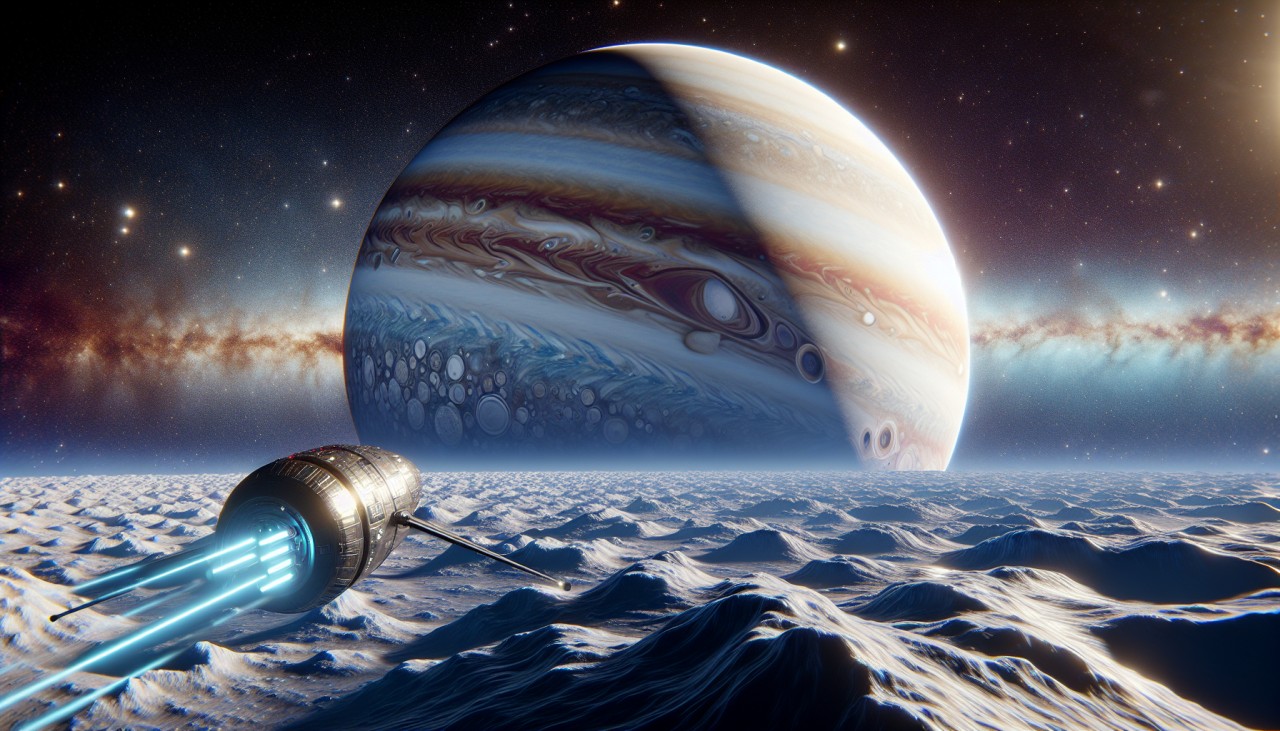
In October 2024, NASA launched the Europa Clipper spacecraft on a mission that has captivated scientists and space enthusiasts alike. This ambitious endeavor aims to explore Europa, one of Jupiter's most intriguing moons, to determine if its subsurface ocean could harbor life. The journey is not just a technological feat but also a quest to answer one of humanity's most profound questions: Are we alone in the universe?
Europa, discovered by Galileo Galilei in 1610, has long been a subject of fascination. Its icy surface conceals a vast ocean beneath, leading scientists to speculate that it may possess the essential ingredients for life—liquid water, chemistry, and energy. The Europa Clipper mission is designed to investigate these possibilities by conducting detailed reconnaissance of the moon's surface and subsurface.
The spacecraft is equipped with nine science instruments, each tailored to gather specific data about Europa's composition, geology, and potential habitability. These instruments include the Mapping Imaging Spectrometer for Europa (MISE), which will analyze the moon's surface composition; the Radar for Europa Assessment and Sounding: Ocean to Near-surface (REASON), designed to probe beneath the icy crust; and the Europa Imaging System (EIS), which will capture high-resolution images of the surface features. Together, these tools will provide a comprehensive understanding of Europa's environment.
One of the mission's primary objectives is to determine the thickness of Europa's icy shell and its interactions with the underlying ocean. Understanding the ice shell's properties is crucial, as it influences the potential for chemical exchanges between the ocean and the surface, a key factor in assessing habitability. The REASON instrument will play a pivotal role in this investigation by sending radar signals through the ice to detect the ocean beneath.
Another significant goal is to study Europa's geology and surface features. The EIS and MISE instruments will work in tandem to map the surface in high detail, identifying geological processes such as tectonic activity, cryovolcanism, and surface deformation. These processes can reveal the moon's geological history and provide insights into the dynamics of its interior.
The mission also aims to assess the composition of Europa's surface and subsurface materials. By analyzing the chemical makeup, scientists can identify organic compounds and other molecules that are fundamental to life. The MISE instrument will be instrumental in detecting these compounds, offering clues about the moon's potential to support life.
Europa Clipper's journey to Jupiter is a testament to human ingenuity and perseverance. The spacecraft is traveling approximately 1.8 billion miles (2.9 billion kilometers) to reach Jupiter, with an expected arrival in April 2030. This long voyage involves gravity-assist maneuvers around Mars and Earth to increase the spacecraft's velocity, a strategy that has been successfully employed in previous missions to distant planets.
The mission's design also takes into account the harsh radiation environment of Jupiter's magnetosphere. Europa Clipper is built to withstand intense radiation, ensuring the longevity and reliability of its instruments. This resilience is crucial for the mission's success, as it will allow for extended periods of data collection and analysis.
As Europa Clipper approaches its destination, the scientific community eagerly anticipates the wealth of information it will provide. The data collected will not only enhance our understanding of Europa but also inform future missions to other icy moons in our solar system. The quest to find life beyond Earth is a driving force in space exploration, and Europa Clipper is at the forefront of this endeavor.
In the coming years, as Europa Clipper conducts its flybys and gathers data, scientists will analyze the findings to assess the moon's habitability. While the mission is not designed to detect life directly, it will provide critical information about the conditions that could support life. This knowledge will be invaluable for planning future missions that may seek to detect signs of life on Europa or other celestial bodies.
The success of the Europa Clipper mission will also have broader implications for our understanding of the solar system. By studying Europa, scientists can gain insights into the processes that govern icy moons and planets, shedding light on the formation and evolution of these bodies. This research can also inform our understanding of exoplanets in other star systems, many of which are similar in size and composition to Europa.
In conclusion, the Europa Clipper mission represents a significant milestone in space exploration. It embodies the spirit of discovery and the pursuit of knowledge, driving us to explore the unknown and seek answers to fundamental questions about our existence. As the spacecraft continues its journey to Jupiter, it carries with it the hopes and aspirations of humanity, eager to uncover the secrets of one of the most enigmatic moons in our solar system.
Key Takeaways
- Europa Clipper aims to determine if Jupiter's moon Europa has conditions suitable for life.
- The spacecraft is equipped with nine science instruments to study Europa's composition and geology.
- Europa Clipper will arrive at Jupiter in April 2030, conducting 49 flybys of Europa during its mission.