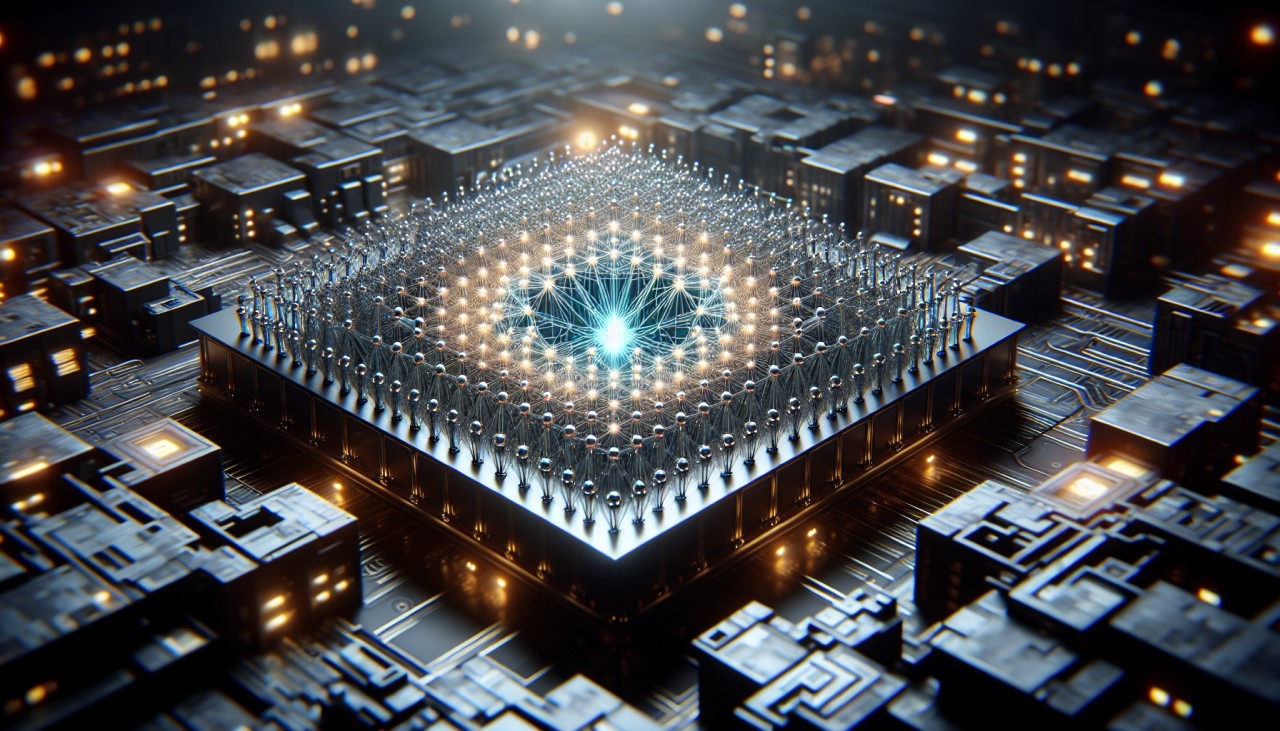
Quantum computing has long been hailed as the next frontier in information technology, promising to solve complex problems that are currently intractable for classical computers. At the heart of this revolution are qubits, the fundamental units of quantum information. Among the various types of qubits, spin qubits have emerged as a particularly promising candidate due to their potential for scalability, stability, and compatibility with existing semiconductor technologies.
Spin qubits leverage the intrinsic spin property of particles like electrons or nuclei to represent quantum states. In essence, the spin of a particle can be oriented in one of two directions—up or down—corresponding to the binary states of 0 and 1. This binary nature aligns well with classical computing systems, facilitating the integration of quantum processors with existing infrastructure.
One of the most significant advantages of spin qubits is their potential for scalability. Traditional quantum computing systems often face challenges in scaling up the number of qubits due to issues like decoherence and operational complexity. Spin qubits, however, can be fabricated using standard semiconductor processes, allowing for the creation of large-scale qubit arrays. This compatibility with existing manufacturing techniques is a game-changer, as it opens the door to mass production of quantum processors.
Recent developments have demonstrated the viability of spin qubits in silicon-based systems. Researchers have successfully created qubits within silicon nanostructures, achieving long coherence times and high-fidelity operations. These advancements suggest that spin qubits could be integrated into existing semiconductor devices, potentially leading to the development of quantum processors that are both powerful and cost-effective.
Another promising avenue is the use of strained germanium quantum wells to scale the number of spin qubits. This approach has shown potential in creating two-dimensional qubit arrays with high device yield, addressing one of the key challenges in quantum computing: maintaining qubit coherence over large numbers. By leveraging strained germanium, researchers aim to build more robust and scalable quantum processors.
The integration of spin qubits into quantum processors also brings the promise of enhanced stability. Unlike other qubit types that may require extreme conditions to maintain coherence, spin qubits can operate at relatively higher temperatures, reducing the need for complex cooling systems. This operational flexibility could lead to more practical and accessible quantum computing solutions.
In terms of real-world applications, the advancements in spin qubits are poised to revolutionize various industries. For instance, in the field of cryptography, quantum computers could break existing encryption methods, necessitating the development of quantum-resistant algorithms. In pharmaceuticals, quantum simulations could accelerate drug discovery by accurately modeling complex molecular interactions. Additionally, quantum computing could optimize logistics and supply chain management by solving complex optimization problems more efficiently than classical computers.
The progress in spin qubit technology also has significant implications for the development of a quantum internet. By enabling secure communication channels based on quantum principles, spin qubits could facilitate the transmission of information that is inherently resistant to eavesdropping. This would mark a substantial advancement in cybersecurity, providing a level of security that is currently unattainable with classical systems.
Moreover, the integration of spin qubits into existing semiconductor technologies could lead to the development of hybrid quantum-classical systems. These systems would combine the strengths of both quantum and classical computing, enabling more efficient processing of a wide range of tasks. Such hybrid systems could be particularly beneficial in fields like artificial intelligence, where complex computations are required.
In conclusion, spin qubits represent a pivotal development in the field of quantum computing. Their scalability, stability, and compatibility with existing technologies position them as a cornerstone for future quantum processors. As research continues and these technologies mature, we can anticipate a transformative impact on computing capabilities, leading to innovations across various sectors of society.
The journey of spin qubits from theoretical concepts to practical applications underscores the dynamic nature of scientific research and technological innovation. It highlights the importance of interdisciplinary collaboration and the continuous pursuit of knowledge in overcoming the challenges inherent in developing quantum technologies. As we stand on the cusp of this new era, the potential for spin qubits to reshape our digital landscape is both exciting and profound.
Key Takeaways
- Spin qubits utilize the intrinsic spin property of particles to represent quantum states, aligning with classical computing systems.
- Their compatibility with semiconductor manufacturing processes allows for the creation of large-scale qubit arrays.
- Advancements in strained germanium quantum wells aim to address challenges in scaling up qubit numbers while maintaining coherence.
- Spin qubits can operate at relatively higher temperatures, reducing the need for complex cooling systems.
- Their integration into quantum processors is poised to revolutionize industries such as cryptography, pharmaceuticals, and logistics.
Example
The development of spin qubits has led to the creation of quantum processors that can simulate complex molecular interactions, significantly accelerating drug discovery processes. This advancement has the potential to bring life-saving medications to market more quickly, improving patient outcomes and reducing healthcare costs.