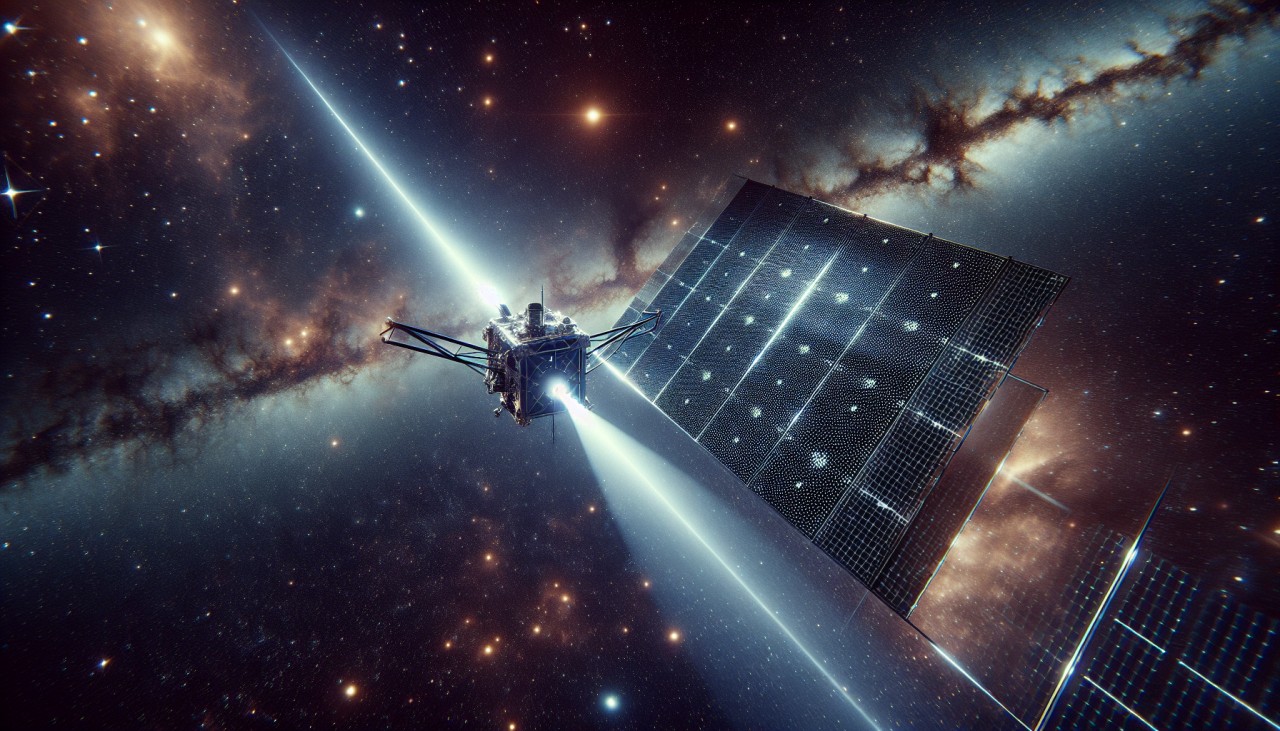
Interstellar travel has long been a captivating concept, inspiring countless scientific endeavors and imaginative visions. Traditional propulsion methods, such as chemical rockets, are insufficient for journeys beyond our solar system due to their limited speed and fuel constraints. However, recent breakthroughs in materials science and physics are paving the way for more feasible interstellar missions. One promising development is the creation of ultra-thin graphene light sails. In a microgravity chamber, researchers successfully demonstrated that a graphene sail, just 3 millimeters wide and weighing less than 250 micrograms, could be propelled by laser beams. This experiment confirmed that light-induced propulsion is viable, marking a significant step toward practical interstellar travel. universetoday.com
Another innovative approach involves photonic propulsion, which utilizes light pressure to accelerate spacecraft. Recent studies have introduced advanced photonic lightsails that incorporate photonics and metamaterials to enhance performance. These sails can achieve near-relativistic speeds, enabling missions to nearby star systems within a human lifetime. By leveraging the momentum of photons, these technologies offer a fuel-free propulsion method, addressing one of the major challenges of interstellar travel. arxiv.org
Key Takeaways
- Graphene light sails have been successfully tested in microgravity, demonstrating light-induced propulsion.
- Photonic propulsion technologies can achieve near-relativistic speeds, enabling missions to nearby star systems within a human lifetime.
- These advancements address the fuel constraints of traditional propulsion methods, offering a fuel-free propulsion solution.