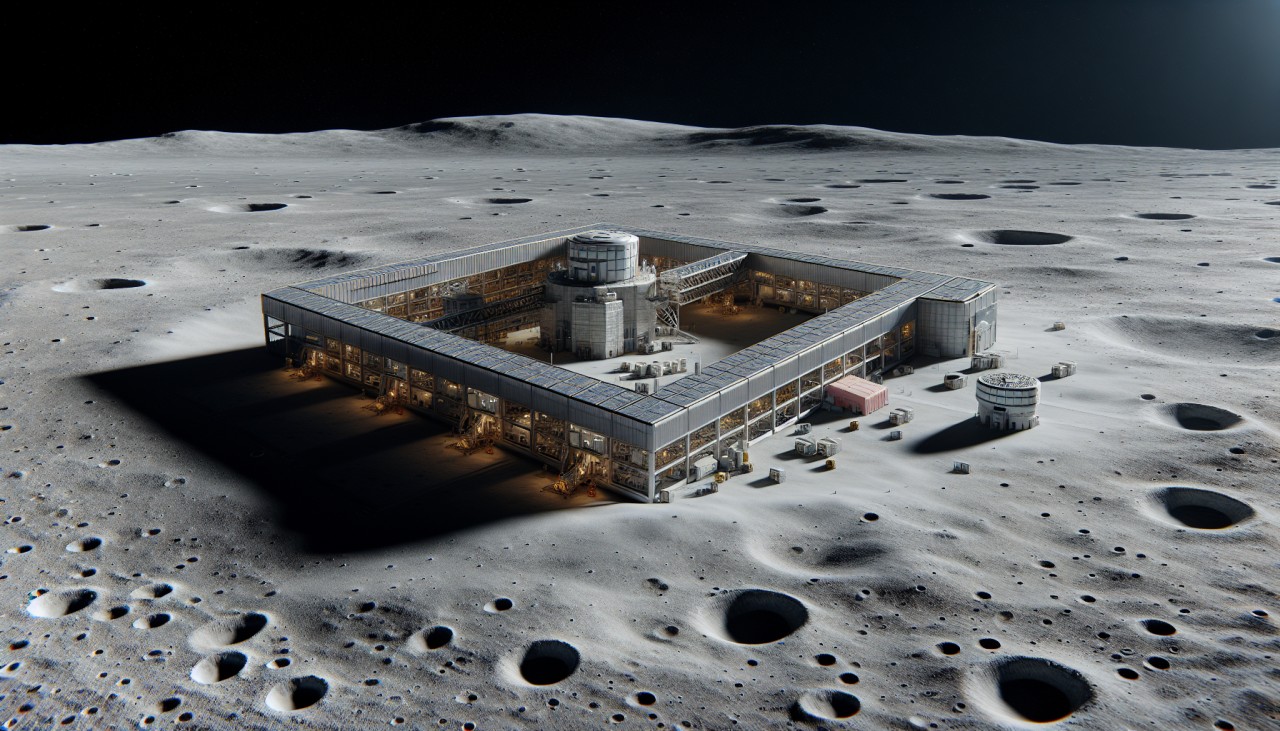
In a significant advancement for lunar construction, Chinese researchers have developed "lunar bricks" crafted from materials that closely resemble lunar soil. Led by Ding Lieyun at the Huazhong University of Science and Technology (HUST), the team utilized a lunar soil simulant to create bricks that are over three times stronger than standard red or concrete bricks. This innovation is a crucial step toward establishing sustainable lunar bases, as it leverages the Moon's native resources, reducing the need to transport materials from Earth. The researchers also explored additive manufacturing by inventing a 3D-printing robot capable of constructing structures using lunar soil, further enhancing the feasibility of in-situ construction on the Moon.
The development of these lunar bricks involved testing five different simulated lunar soil compositions and three sintering processes to optimize material selection and construction methods. The team plans to send the lunar bricks to China's space station aboard the Tianzhou-8 cargo spacecraft to assess their mechanical and thermal performance, as well as their ability to withstand cosmic radiation. This testing is essential to ensure the bricks' durability in the Moon's harsh environment, characterized by extreme temperature fluctuations and high radiation levels. The first lunar brick is expected to return to Earth by the end of 2025, providing valuable data for future lunar base construction.
Key Takeaways
- Chinese researchers have developed "lunar bricks" using lunar soil simulants.
- The bricks are over three times stronger than standard red or concrete bricks.
- A 3D-printing robot has been created to construct structures using lunar soil.
- Five simulated lunar soil compositions and three sintering processes were tested.
- The lunar bricks will undergo performance testing in space, with the first brick returning to Earth by late 2025.